The Structure Moves Before the Money Moves.
A former customer called me this week, out of the blue. Their business, a local service company that has historically gotten the majority of its work through Google, is down 50% in six months. A few minutes into the call they started telling me about "this new thing called zero-click search," and I stopped them, because I knew the rest. It was the tenth call like it I've taken in the past few months. The calls are getting familiar.
What's happening to them is downstream of the data structure the whole local economy sits on, and the structure moves before the money moves. Maybe there's a nearer cause mixed into their specific drop, and we'll look for it. The structural shift is coming for their category either way. Their revenue just got the news early. By the end of the call, they'd signed on for us to help them navigate it.
I've been on the structure side of this since 2008. Back then I ran a marketing agency, and the playbook was simple: find a corner of Google nobody was defending and give the machine good, crawlable information. What you do, where you are, what it costs, written plainly on pages a crawler could read. The plumber who won his neighborhood searches in 2009 wasn't smarter than his competitors. His information was structured better, and he ate off that position for years. We ran that play for hundreds of small businesses, and I still do this work every day. The machines changed. The work didn't.
An economy built on discovery of many
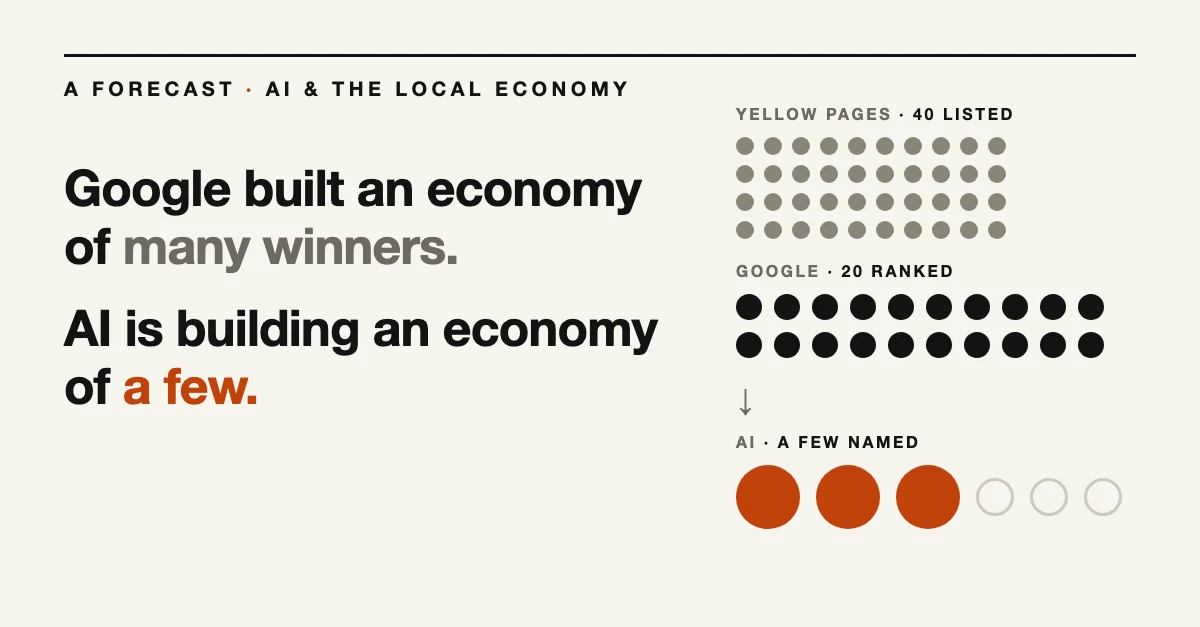
Here's the part that matters more than search. The US economy, especially at the local level, was structured around the discovery of many. Google didn't invent that; it inherited it. The Yellow Pages listed forty plumbers and let you pick. Main Street existed so twenty storefronts could be walked past. The local paper sold an ad to every one of them. None of it was fair. The Yellow Pages sold the top of the page, and half the plumbers in it were named AAA-something for the alphabet. A name like AAA Plumbing was SEO before SEO existed. But even a rigged directory kept everybody visible: the buyer walked past the other thirty-nine listings on the way to the one that paid. Every discovery layer this country has run made the same two promises: many businesses can be found, and the customer does the choosing.
Small business America is built on those promises. Drive time and capacity decide how many businesses a town can hold. Discovery decided which of them got fed, and it spread the feeding around. It's why a town carries twenty restaurants and fifteen contractors and a dozen dentists, why opening one more was a reasonable bet, why a bank would write the loan behind it. Somebody would find you. Google's era just made the math visible: one shop ranked for the emergency search, another for the repair search, another owned the map, another had four hundred reviews doing the talking. The customer did the evaluating: search, scan, open three tabs, call two places. The decision came after the evaluation, and the evaluation belonged to the customer, so attention spread out. Unevenly, sure. But it spread, and enough businesses got fed to keep every category full. A whole generation of small businesses got built on that math without ever thinking of it as math.
The key change
That evaluation has now been outsourced, and the structure goes with it. Discovery of many is becoming discovery of few. That's the key change. Everything else in this piece is a ripple of it, and one ripple matters more than the rest: every structural change in discovery has minted a new class of winners. The Yellow Pages minted theirs. Google minted a whole generation; I helped some of them get minted. This cycle will mint its own, and the seats are still mostly empty.
Google is rolling AI Overviews out vertical by vertical, and where it lands, the comparing gets pulled off the page and done by the machine. This customer watched it land: when the overviews started showing up on their searches, the clicks fell off fast. And we've watched the same thing hit vertical after vertical over the past sixteen months; residential services took it last year. Different verticals, different dates, one rollout, and the order is the tell. One by one, Google knocks them down. Whether the whole 50% traces to this, neither of us can prove yet. The rollout schedule is the impact schedule, and vertical by vertical, Google is changing the structure of small business.
The machine doing the comparing isn't working from a typed phrase the way the search box did. It knows where you are. It's learning your budget, your history, what you said you cared about last month. Some of that is live today; the rest is a product cycle away, and the assistants are racing each other to close it. Google matched a phrase. The assistant matches a person. It hands back a conclusion with two or three names on it, and the customer's job shrinks from evaluating to confirming.
The canaries
This is not one company's bad year. Look at who's already been through it. Business Insider's search traffic fell more than 85%, and it cut a fifth of its staff. Chegg, a company built on students finding it through Google, watched non-subscriber traffic drop by half, sued Google over the overviews, and started shopping itself. Stack Overflow, the site every programmer lived on, has seen new questions collapse by more than three quarters since ChatGPT launched. Across 2,500 news sites tracked by Chartbeat, Google referrals fell by a third in a single year, and small publishers are down 60% over two. Different industries, one mechanism: the answer arrives, the visit doesn't. Publishers and reference sites were the canary. Local business is the rest of the mine.
Who's exposed
Look at who lives on that moment of being found. Local, intent-based search was never the big brand's channel. It belongs to the small operator: the roofer, the plumber, the autobody shop, the med spa. No national brand, no ad budget that matters, just being found at the moment somebody nearby needs the thing. That moment is what's being restructured, which is why this lands on small business almost exclusively.
The economics invert
Now run the economics, because the ripples go a lot further than marketing budgets. Revenue concentrates first: twenty winners per category per city, cut to a few. The few will feast, with more volume than one storefront used to see. The rest won't fail loudly. Their phones ring a little less each quarter, the owners blame the economy, and nothing shows up in any report, because the loss happens upstream where no dashboard looks. The lost lead never looks like a lead. It looks like a slow year.
Then it ripples outward, because the small and medium business economy is priced on discovery of many. Who opens the twenty-first HVAC shop in a town where the machine names three? Who writes the loan behind it, who signs the lease, who takes the job there? Formation, lending, commercial rents, local employment: all of it quietly assumes that a decent new business can get found. Change that assumption and you haven't changed marketing. You've changed the terms the whole local economy runs on.
The honest objection: Google already cut the local map pack from seven to three in 2015, zero-click passed half of searches by 2019, and new-business formation hit records anyway. True. But both of those cuts still left the customer doing the choosing. This one takes the choosing away, and that's the bet. It's checkable: if formation and lending haven't moved within a few years of assistants becoming the default, I was right about the marketing and wrong about the economy.
The forecast
Here's how I think it plays out. Hold me to it.
Start with the part the doom crowd skips: this is a re-sorting, and re-sortings mint winners. The businesses that fed the crawler in 2008 got a decade out of it. The businesses that feed the answer engines now are lining up for the same kind of run, and in most categories, in most cities, nobody has claimed the seat yet.
The shakeout runs vertical by vertical, on the answer surfaces' schedule, Google's first. Every owner gets a window between watching another industry take the hit and taking it themselves, and most will waste the window. Personalization cuts both ways in this: for dinner it spreads people out, because nobody wants the same restaurant twice, but for a burst pipe at 11pm there's one right answer and the machine gives it. The categories that concentrate first are the urgent ones, where nobody was shopping for variety anyway. Inside those, the winners' problem flips from getting chosen to delivering, so capacity consolidates under them. They'll buy the trucks, the techs, and the licenses off the businesses that went quiet. Demand concentrates first. Capacity follows it.
I build software in this space, so weigh this next part accordingly. A new layer of businesses gets minted in the middle: companies whose whole job is making messy local reality legible to machines. Structuring the data, verifying the claims, watching who gets named for what. In 2008 the opportunity was a weird little niche in Google. The niches are back, one layer up, and the operator-grade versions are still mostly unbuilt.
The refactor
For everyone already in the game, strategy has to be refactored around one idea: you are the answer, not the destination. Since 2008, strategy meant pulling the customer to you, your site, your store, your phone line, and winning them there. That website is demoting from storefront to evidence file. The marketing dollar moves from attracting visitors to feeding the machine a record it can trust: prices, reviews, proof, the same facts everywhere it looks. Feeding the machine good, crawlable information was the whole playbook in 2008. It's the whole playbook now. The stakes changed. The discipline didn't.
This forecast is the bet I'm making with my own money, and the data I see across the stores my software serves is what convinced me. You don't need to take my word for it. Ask an assistant tonight what your customers would ask, and watch who gets named.
Most businesses will skip this, the way most skipped SEO in 2008. The ones who didn't skip it then got minted as that cycle's winners and owned their markets for years. The next batch of winners is being chosen right now. Same choice. Shorter window.